
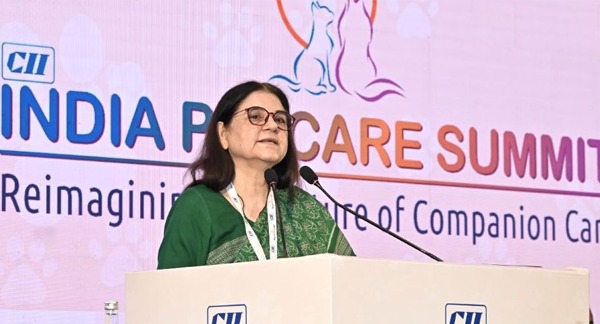
Animal welfare cannot be viewed in isolation from public health, urban planning, veterinary education, or environmental sustainability. That was the central message given by Smt Maneka Gandhi, India’s foremost animal rights advocate and former Union Minister, during the India Petcare Summit 2026, organised by the Confederation of Indian Industry (CII).
Addressing policymakers, veterinarians, pharmaceutical companies, researchers and industry leaders, Gandhi urged stakeholders to move beyond conversations centred on the growing pet care market and instead build a humane, science-driven national framework for animal welfare.
“The future of the pet care sector cannot be discussed in isolation. It is no longer about pets, products or markets. It is about veterinary education, public health, urban planning, animal welfare and policy.”
Animal Welfare Is Public Health
Maneka Gandhi emphasised that human health, animal health and environmental health are inseparable. Referring to the globally recognised One Health approach, she argued that diseases such as rabies and other zoonotic infections cannot be controlled without investing in animal health.
According to her, India’s response to animal-related public health challenges has largely remained reactive, focusing on culling or relocating animals instead of implementing scientific, long-term solutions.
“Conflict between people and animals cannot be solved through reaction or removal. It can only be addressed through scientific population management, responsible waste management, vaccination and sustained investment.”
Animal Birth Control Must Become a National Priority
One of Gandhi’s strongest recommendations was to strengthen the Animal Birth Control (ABC) programme across the country. She described sterilisation as the only humane, scientific and legally recognised long-term solution for managing free-roaming dog populations.
However, she expressed serious concern over the poor implementation of existing programmes, citing inadequate infrastructure, lack of trained veterinarians, weak monitoring mechanisms and widespread irregularities in several centres.
Maneka Gandhi called upon the pharmaceutical industry to become an active partner in establishing professionally managed ABC centres through public-private partnerships and Corporate Social Responsibility (CSR) initiatives.
Investing in Infrastructure, Not Crisis Management
A recurring theme throughout her address was the urgent need for investment in veterinary infrastructure.
She advocated professionally managed government shelters, fully equipped veterinary hospitals with inpatient facilities, emergency rescue services, ambulances, anti-rabies vaccination programmes and stronger disease surveillance systems.
She maintained that every district should have accessible veterinary facilities capable of providing quality treatment and post-operative care, particularly in rural India.
Reforming Veterinary Education
She focussed on veterinary education, arguing that India needs better-trained, more compassionate veterinarians.
She observed that veterinary colleges should place far greater emphasis on animal welfare science, community medicine, behaviour, pain management and shelter medicine, while encouraging practical training through internships at animal shelters and rescue organisations.
She also encouraged the pharmaceutical industry to invest in world-class veterinary institutions in collaboration with international partners, arguing that stronger education would ultimately strengthen India’s entire animal healthcare ecosystem.
Industry Must Lead Through CSR
While acknowledging the rapid growth of India’s pet care industry, Gandhi urged companies to measure success not only by market expansion but by their contribution to society.
She called upon industry leaders to invest their CSR resources in animal shelters, sterilisation programmes, veterinary education, research, diagnostics and preventive healthcare. “The success should be measured not by market growth but by the public good that you create.”
She added that businesses supporting animal welfare would ultimately earn something more valuable than commercial success.
Prevention Over Reaction
Maneka Gandhi stressed that prevention is significantly more effective and economical than responding to crises after they occur. Investments in vaccination, sterilisation, veterinary capacity and scientific management, she argued, would not only improve animal welfare but also strengthen public health and reduce the burden of zoonotic diseases.
She urged governments, industry, veterinarians, NGOs and citizens to work together to create a sustainable ecosystem where humans and animals can safely coexist.
Maneka Gandhi expressed hope that the summit would inspire concrete action rather than remain another discussion forum.