

Nutrition is not supportive care in kidney disease—it is therapeutic intervention. Improper nutrition accelerates nephron loss, whereas appropriate dietary management slows disease progression, reduces uremic toxicity, preserves muscle mass, and improves survival.
- Why Nutrition Is Central to Kidney Disease Management
The kidneys are directly involved in:
- Excretion of nitrogenous waste
- Regulation of minerals (P, Ca, Na, K)
- Acid–base balance
- Hormonal regulation (erythropoietin, vitamin D)
When kidney function declines:
- Normal dietary nutrients become metabolic burdens
- Waste products accumulate
- Muscle protein is broken down to meet energy needs
diet must be modified to match reduced renal capacity.
- Protein Nutrition – Quantity, Quality, and Metabolism
2.1 Protein Metabolism in Kidney Disease
- Dietary protein → amino acids → used for tissue synthesis
- Excess amino acids → deamination → nitrogen waste (urea, ammonia)
- Diseased kidneys cannot efficiently excrete these wastes
Result:
- Uremia
- Nausea
- Anorexia
- Increased muscle catabolism
2.2 Protein Quantity (Crude Protein Level)
Common misconception: “Kidney dogs should eat very low protein”
Scientific truth:
Protein restriction should be moderate and stage-specific.
CKD:
- Excess protein → ↑ uremic toxins
- Severe restriction → muscle wasting, immune suppression
|
Disease Stage |
CP (% DM) |
Rationale |
|
Early CKD |
18–22% |
Maintain body protein |
|
Moderate CKD |
14–18% |
Reduce nitrogen load |
|
Advanced CKD |
12–14% |
Control uremia |
AKI:
Protein should not be restricted initially because:
- High catabolic state
- Tissue breakdown already ongoing
2.3 Protein Quality – High Biological Value (HBV)
HBV proteins:
- Provide essential amino acids efficiently
- Produce less nitrogen waste per gram utilized
Examples (Indian context):
- Egg white (gold standard)
- Milk proteins (curd, paneer – controlled quantity)
- Properly processed soy isolate

2.4 Ideal Amino Acid Balance
In CKD:
- Dogs may consume less food
- Amino acid imbalance worsens muscle loss
Critical amino acids:
- Lysine → muscle synthesis
- Methionine → antioxidant support
- Threonine → gut integrity
- Tryptophan → appetite regulation
Diets must supply essential amino acids even with lower CP.
- Energy Management – Preventing Protein Catabolism
3.1 Why Energy Is More Important Than Protein
- Low energy intake forces body to break muscle protein
- Muscle breakdown → more nitrogen waste → worsened uremia
Target energy: 95–130 kcal/kg⁰·⁷⁵/day
3.2 Energy Sources
Fat:
- Primary energy source
- Protein-sparing
- Improves palatability
Carbohydrates:
- Easily digestible
- Reduce reliance on amino acids for energy
High energy + moderate protein = muscle preservation
- Muscle Wasting (Protein–Energy Wasting) in CKD
Mechanisms:
- Reduced appetite
- Metabolic acidosis
- Inflammation
- Hormonal imbalance
- Inadequate amino acid intake
Clinical Importance:
- Loss of muscle occurs before fat loss
- Strong predictor of poor prognosis
Nutritional correction:
- Adequate energy
- HBV protein
- Correction of acidosis
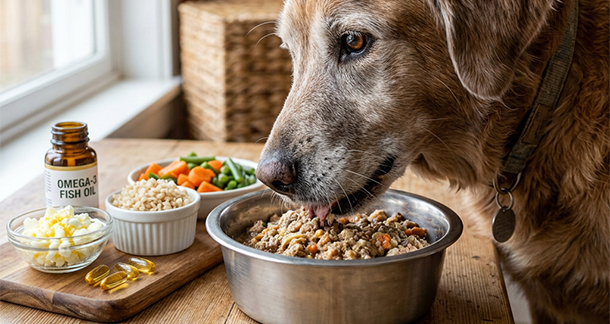
- Omega-3 supplementation
- Phosphorus Management – Slowing Disease Progression
Why Phosphorus Is Dangerous in CKD
- Reduced excretion → hyperphosphatemia
- Triggers secondary renal hyperparathyroidism
- Causes bone demineralization and renal fibrosis
Dietary target:
≤0.4–0.6% DM
Strategies:
- Select low-P protein sources
- Avoid bone meal, fish meal
- Use phosphate binders if required
- Calcium–Phosphorus–Vitamin D Axis
- CKD disrupts vitamin D activation
- Leads to calcium imbalance
Dietary approach:
- Maintain Ca:P ratio 1.2–1.4:1
- Avoid excess calcium supplementation
- Sodium and Blood Pressure Control
- CKD dogs often develop hypertension
- Sodium increases glomerular pressure
Dietary sodium:
0.08–0.25% DM
Not salt-free, but controlled sodium
- Potassium and Acid–Base Balance
Hypokalemia:
- Causes muscle weakness
- Worsens kidney damage
Metabolic Acidosis:
- Promotes muscle protein breakdown
- Reduces growth hormone action
Nutritional correction:
- Balanced mineral profile
- Alkalizing diet if required
- Fatty Acids and Renal Protection
Omega-3 Fatty Acids (EPA, DHA)
Renal benefits:
- Reduce glomerular inflammation
- Lower proteinuria
- Improve renal blood flow
- Gut–Kidney Axis and Functional Nutrition
CKD alters gut microbiota:
- Increased pathogenic bacteria
- Increased uremic toxin production
Dietary interventions:
- Prebiotics (inulin, FOS)
- Postbiotics
- Improve gut barrier integrity
- Reduce systemic inflammation
- Avoidance of Nephrotoxic Dietary Factors
Common toxins:
- NSAIDs
- Heavy metals
- Mycotoxins
- High oxalate foods
- Unverified herbal supplements
- Nutritional Differences: AKI vs CKD
|
Factor |
AKI |
CKD |
|
Protein |
Adequate |
Restricted (moderate) |
|
Energy |
High priority |
High priority |
|
Phosphorus |
Monitor |
Restrict |
|
Duration |
Short-term |
Lifelong |
|
Goal |
Recovery |
Slow progression |
By Dr Vikash Raj , B.V.SC&A.H, MVSC (ANIMAL NUTRITION) (WBUAFS).
Vikashnutrition81@gmail.com