

Introduction
In October edition part we discussed the needs of a growing puppy, its age wise classification, homemade diet, common feeding mistakes. In this part we will discuss digestibility, why it matters, fat and essential fatty acids, fibre and other essential nutrients.
- Digestibility: Why It Matters
Digestibility refers to the proportion of a consumed nutrient that is apparently digested rather than excreted in faeces.
Example
A puppy consumes: 100 g protein
and excretes: 20 g protein in faeces
Then: Apparent digestibility = [(100 – 20) / 100] × 100 = 80%
Important distinction
Crude protein→ digestibleprotein → absorbed amino acids
Digestibility can be influenced by:
- Ingredient quality
- Processing
- Cooking
- Protein source
- Fibre level
- Anti-nutritional factors
- Starch digestibility
- Gastrointestinal health
- Digestibility and Stool Quality
A well-digested diet may generally result in:
- Well-formed stools
- Lower faecal volume
- Appropriate stool frequency
- Less undigested material
Poor digestibility may contribute to:
- Large faecal volume
- Loose stools
- Excessive defecation
- Flatulence
- Poor nutrient utilization
However, stool appearance alone cannot accurately measure nutrient digestibility.
- Fat and Essential Fatty Acids
Fat is a concentrated source of energy. In AAFCO’s modified Atwater system, fat contributes approximately 8.5 kcal/g, compared with approximately 3.5 kcal/g for protein and carbohydrate for calorie estimation purposes.
Fat also supports:
- Cell membranes
- Skin and coat
- Absorption of fat-soluble vitamins
- Energy supply
- Essential fatty acid nutrition
Sources may include: poultry fat, fish oil, animal fats, vegetable oils.
- Omega-3 Fatty Acids
Important omega-3 fatty acids include: ALA, EPA, and DHA. DHA is particularly relevant to developing neural and visual tissues. Fish oil can provide EPA and DHA depending on the product and source.
However:
A puppy eating a complete and balanced food does not automatically require additional supplements. Supplementation should be based on the actual diet and veterinary advice.
- Carbohydrates
Dogs can utilize carbohydrates effectively. Common carbohydrate ingredients include: rice, maize, wheat, oats, barley, legumes.
Carbohydrates can provide: energy, starch, dietary fibre, and useful functional properties in processed foods.
Important point: Dogs do not require carbohydrates in the same essential-nutrient sense as they require essential amino acids and certain essential fatty acids. But appropriately formulated carbohydrate sources can be useful components of a complete diet.
- Fibre
Fibre can contribute to: stool quality, gastrointestinal function, intestinal fermentation, microbial activity, satiety.
Common sources include: beet pulp, cellulose, psyllium, vegetable fibres, cereal fibres.
The quantity and type of fibre matter because excessive fibre can reduce energy density and alter nutrient utilization.
- Calcium and Phosphorus
Calcium is essential for: bones, teeth, muscle contraction, nerve function, blood clotting.
Phosphorus contributes to: bone mineralization, ATP and energy metabolism, cell membranes, nucleic acids.
Both nutrients must be considered together.
Common mistake
“My puppy needs calcium, so I should give calcium syrup every day.” – Not necessarily. If a puppy is consuming an appropriate complete and balanced growth diet, additional calcium may be unnecessary and can disturb nutritional balance. This is particularly important in large and giant breeds.
- Understanding Ingredients
Pet parents often select a food based on its first few ingredients.
|
Ingredient |
Potential nutritional contribution |
|
Fresh chicken |
Protein, amino acids, water |
|
Chicken meal |
Concentrated animal-derived protein/minerals |
|
Fish meal |
Protein and minerals |
|
Egg |
Highly digestible protein and nutrients |
|
Rice |
Starch and energy |
|
Maize |
Starch, energy and some protein |
|
Oats |
Carbohydrate and fibre |
|
Animal fat |
Concentrated energy |
|
Fish oil |
Fat and EPA/DHA depending on source |
|
Beet pulp |
Fibre |
|
Vitamin-mineral premix |
Micronutrients |
Remember: Ingredients are the vehicles through which nutrients are supplied. The final nutritional adequacy of the food is more important than whether one particular ingredient appears first on the label.
AAFCO explains that ingredients are generally listed by weight and that the nutritional adequacy statement is an important part of interpreting pet-food labels.
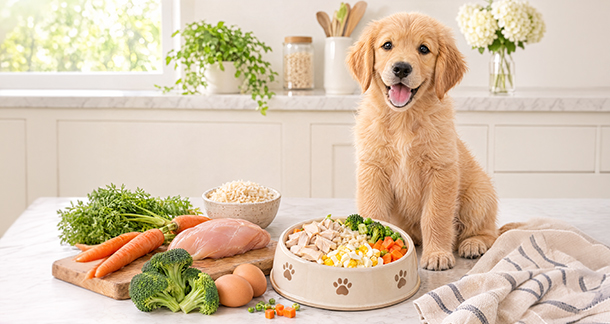
- Fresh Meat Vs Meat Meal
Fresh meat contains considerable water. Meat meal has undergone processing that removes much of its moisture.
Therefore: The position of a fresh meat ingredient on an ingredient list cannot be interpreted as if it contains the same dry nutrient concentration as a dehydrated meal.
This is one reason why ingredient-list marketing can sometimes be misleading if viewed without the guaranteed analysis and nutritional adequacy statement.
- What Does “Complete and Balanced” Mean?
For pet parents, this is one of the most important concepts.
Complete means the food provides the required nutrients.
Balanced means those nutrients are provided in appropriate amounts and proportions.
For puppies, parents should select a food whose nutritional adequacy is appropriate for growth or an appropriate all-life-stages claim.
AAFCO emphasizes selecting food according to species, life stage and the individual animal’s condition.
- Homemade Diets for Indian Puppies
Common combinations include: rice + chicken, rice + egg, roti + milk, chicken + vegetables, rice + fish, homemade meat-and-rice diets.
These can contain useful nutrients, but they are not automatically complete and balanced for growth.
Potential nutritional gaps may involve: calcium, phosphorus, zinc, copper, iodine, vitamin D, vitamin E, essential fatty acids, and specific amino acids.
Better approach
If a pet parent wants to feed a homemade diet: Use a properly formulated recipe designed specifically for the puppy’s life stage and expected adult size, preferably under veterinary nutrition guidance.
- Feeding Frequency by Age
|
Age |
General feeding pattern |
|
4-8 weeks |
4 meals/day, depending on weaning status |
|
8-12 weeks |
3-4 meals/day |
|
3-6 months |
3 meals/day |
|
6-12 months |
2-3 meals/day |
|
Mature adult |
Usually 2 meals/day |
These are general guidelines. Actual feeding should be adjusted according to food energy density, body condition, growth rate and individual needs.
- Small-Breed Vs Large-Breed Puppies
|
Feature |
Small breed |
Large/giant breed |
|
Maturity |
Earlier |
Later |
|
Energy per kg |
Generally higher |
Must avoid excessive calorie intake |
|
Stomach capacity |
Small |
Larger |
|
Main concern |
Adequate energy intake |
Controlled growth |
|
Calcium supplementation |
Usually unnecessary if diet is complete |
Particularly avoid indiscriminate supplementation |
|
Monitoring |
Body weight + condition |
Growth + body condition + skeletal development |
- Treats and Supplements
Treats include: biscuits, commercial treats, bread, roti, table food, pieces of human food. These should not replace a complete puppy diet.
Be careful with supplements: Avoid automatically combining Puppy food + calcium + multivitamin + liver + milk + additional supplements without considering total nutrient intake.
More supplements do not necessarily mean better nutrition.
- Common Feeding Mistakes in Indian Puppies
|
Common practice |
Potential problem |
|
Rice + chicken only |
Nutritional imbalance |
|
Excess calcium |
Mineral imbalance |
|
Milk after weaning |
GI upset in some puppies |
|
Too many treats |
Excess calories |
|
Table scraps |
Nutritional imbalance/toxic foods |
|
Sudden food change |
Digestive upset |
|
Feeding unlimited food |
Excess weight gain |
|
Choosing only by protein % |
Ignores energy and amino-acid balance |
|
Choosing only by first ingredient |
Does not establish complete nutrition |
|
Internet homemade recipes |
May not meet growth requirements |
- Energy and Protein Calculation: Practical Example
Example puppy: Body weight = 10 kg
Suppose, for illustration, that the calculated daily energy requirement is 600 kcal/day.
Food contains 4 kcal/g and 30% crude protein.
Step 1: Calculate food quantity
600 / 4 = 150 g/day
Step 2: Calculate crude protein intake
150 × (30 / 100) = 45 g crude protein/day
Step 3: Consider digestibility
If apparent protein digestibility were 80%:
45 × 0.80 = 36 g
Approximately 36 g of the consumed crude protein would be apparently digested.
Important: This is an illustration of calculation, not a universal recommendation that every 10-kg puppy needs exactly 600 kcal or 45 g protein.
- Growth Monitoring
Food quantity should not remain fixed throughout puppyhood. Monitor: body weight, body condition, growth rate, stool quality, appetite, activity, coat/skin condition, gastrointestinal signs.
|
THE GOAL |
- Myths Vs Facts
|
Myth |
Fact |
|
More calcium means stronger bones |
Calcium must be provided in appropriate amounts and balance |
|
More protein means better growth |
Protein quality and amino-acid balance matter |
|
Rice and chicken is complete |
Not automatically |
|
Milk is essential after weaning |
Not necessary when a balanced diet is provided |
|
Highest protein food is always best |
Energy density and nutrient balance also matter |
|
Homemade means healthier |
Only if nutritionally formulated |
|
Fat is bad for puppies |
Appropriate fat is an important energy and fatty-acid source |
|
Grain-free is automatically healthier |
Ingredient exclusion does not automatically establish nutritional superiority |
|
A fat puppy is a healthy puppy |
Excess body fat is undesirable |
|
More supplements mean better health |
Excess supplementation can cause imbalance |
About the Author
- VIKASH RAJ
M.V.Sc (ANIMAL NUTRITION)
Email: VIKASHNUTRITION81@GMAIL.COM
WEST BENGAL UNIVERSITY OF ANIMAL AND FISHERY SCIENCES