
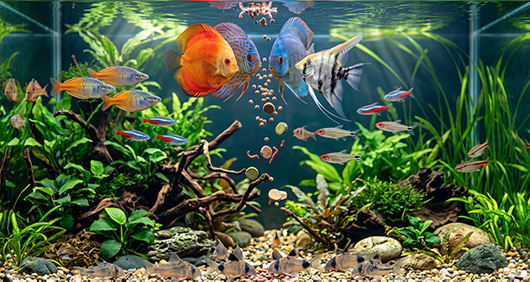
For a healthy aquarium along with good filtration, regular water changes and stable water parameters what is the most important and probably ignored part? Its their nutrition. While the above are essential but we generally ignore the health/nutrition of the fishes which should also get the same attention.
Proper nutrition influences growth, coloroation, immunity, breeding success, color development, digestions, stress resistance, and even lifespan. A fish that receives a balanced diet is naturally more resilient against disease and adapts better to changes in its environment. Always try to mimick the diet which is close to their nature.
In nature each fish have different types of diet – some are omnivorous, some are carnivorous. Their diets vary with seasons, regions, habitat, age, and even the time of day. Yet in captivity, we try to force fed them with one type of food without looking into the specifics. Although they may survive but may not thrive.
Herbivores fishes require a diet rich in plant matter and fibre – in nature they eat algae, plant matter and their digestion system is evolved that way, these animals in captivity if fed with animal protein diet they will eat it but it will be a massive overload on their digestion system which can lead to collapse. Carnivores depend on high-quality animal proteins – in nature they eat insect, other fishes and some types reptiles, amphibians also, these preys are generally below than the body mass of the fishes which makes their digestion easier, feeding them fish meal in aquarium leads to the collapse of their digestion system too. Omnivores need a balanced combination of both – in nature along with algae, plants these happily consume shrimps, krills, snails, etc. Feeding every fish in a community aquarium the same food is convenient, but it is rarely ideal.
Overfeeding is one of the largest mistake which every hobbyists does, these excess food spoils the water parameters of the aquarium by increasing ammonia, nitrate levels which are toxic for the fishes. In nature fishes eat the quantity they need, follow the same in your aquarium too, feed which they can consume in few minutes, you can increase the feeding cycles than dumping all at one go.
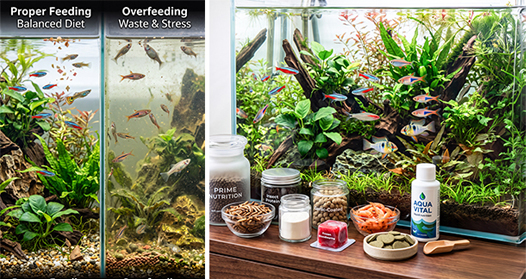
Fishes lips are soft – in nature they are evolved to eat insects, algae matters so feeding them hard extruded pellets is not ideal for their diet. These pellets take time to digest and often does bloating. Also in nature varied diets is available to fishes so try to mimick the same in aquarium too – rotate between soft pellets, paste food, frozen foods etc to increase the fishes nutrition profile.This approach closely resembles the diversity they experience in nature.
Food quality matters as much as food quantity. Premium ingredients, stable vitamins, digestible proteins, and carefully selected natural pigments produce healthier fish than feeds made primarily with inexpensive fillers. Investing in better nutrition often reduces disease outbreaks and improves long-term success, making it economical in the long run. A diet with insect protein, probiotcs, garlic coated is ideal to increase their apetite and provide neccesary probiotics and prebiotics for their overall well being.
Aquarium keeping as an hobby has gone through leaps and bounds in past decade or so, now hobbyists have access to advanced literature, data, parameters which is supposed to make their life more easier so please go through it. Consider this way – an aquarium foundation is dependent on water parameters, filtration, similarly a fishes diet in dependent upon quality food. You try to save 100 rupees by going for an inferior food may reduce your fishes life span by months
Healthy aquariums are not built by equipment alone—they are built one balanced meal at a time. When hobbyists focus on nutrition alongside water quality, they don’t just keep fish alive; they help them display their natural colours, behaviours, and vitality.
The next time you admire or want to keep a beautiful aquarium, remember that behind every vibrant fish is not just clean water, but a thoughtfully planned diet. Good nutrition is no longer an option—it is one of the foundations of responsible fishkeeping. Its not just for fishes but for any animal inlcuding us – a good diet keep us going.