
Pet-food packaging has a difficult job. It has to protect food from moisture, oxygen and contamination, survive transport, keep products shelf-stable and, in many cases, cope with being opened and closed repeatedly at home.
Once the food is gone, things become less straightforward.
For Indian pet parents, whether a pack can be recycled depends on two things: what the pack is made from and what is actually collected where they live.
Those are not always the same thing.
Start with the whole pack, not the symbol
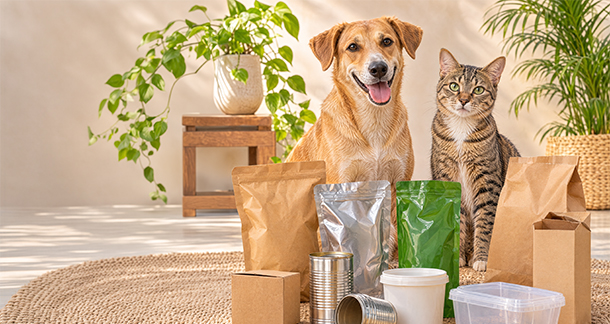
Pet food comes in rigid plastic tubs, flexible pouches, laminated bags, metal cans and cartons made from several materials. Some packs also include zippers, spouts, labels or liners made from something different from the main body.
Indian plastic-waste rules recognise those differences. The Central Pollution Control Board classifies packaging into categories including rigid plastics, flexible plastic packaging and multi-layered structures. Resin-identification markings are also used for common plastics such as PET, HDPE, LDPE and polypropylene.
Those markings can help identify a material, but they do not tell you whether the finished pack is accepted by your local recycling system.
A dry-food bag is a good example. It may contain several layers because the food needs protection from moisture and oxygen. One of those materials may be recyclable on its own, while the complete bag is much harder to process.
So the recycling symbol is a starting point, not a complete disposal instruction.
Check what your local collector accepts
There is no single household recycling route that works the same way everywhere in India.
Collection and sorting arrangements differ between cities, municipal bodies, housing societies, private contractors and informal-sector recyclers. What is accepted in one place may not be accepted in another.
The most useful question is therefore a local one: does your dry-waste collector take this type of packaging?
For plastic packs, it is worth checking whether they accept rigid containers, flexible films and pouches, or multi-layered packaging. These may all be handled differently.
Apartment complexes often have their own arrangements, while some retailers and organisations provide collection routes for particular materials.
If there is no suitable route where you live, putting difficult packing into a recycling bin does not solve the problem. It may simply be removed later during sorting.
Separate parts where the pack is designed for it
Some packaging has components that are clearly intended to come apart.
A lid, cap, sleeve or outer carton may need to be separated from the main pack because it follows a different waste route. If the manufacturer provides instructions, follow them.
That does not mean dismantling a multi-layer pouch yourself. Cutting apart a laminated structure will not magically turn its bonded layers into separate recyclable materials.
Cleaning is another area where common sense helps.
Collectors may ask for food residue to be removed, but there is little point using large amounts of hot water and detergent on a pack that has no viable recycling route in the first place.
The collection system you are actually using should determine what preparation is needed.
Why pet-food packaging is complicated
Packaging is not designed around recycling alone.
Food safety comes first. Barrier layers can protect against oxygen, moisture, light and contamination, while seals need to hold up through transport and storage.
Creature Companion recently covered Drools’ use of Tetra Recart packaging for fresh pet food in India. The format allows food to remain shelf-stable before opening, which is a useful reminder that a pack may be doing much more than simply holding the product.
The challenge for packaging designers is to improve end-of-life options without losing those functions.
That is already part of the wider packaging conversation in India. The India Plastics Pact has published guidance for flexible packaging that includes pet-food applications and looks at what can realistically be mechanically recycled using infrastructure available in the country.
That real-world infrastructure matters just as much as material specification.
Brands can make disposal easier
Pet parents should not need to understand polymer science to work out what to do with an empty food pouch.
Clearer packaging information would help.
If only one component is recyclable, say which one. If the pack needs to be separated, explain how. If it depends on a particular collection route, make that clear rather than relying on a broad recycling symbol.
This becomes especially important when packaging changes.
A lighter pouch, new mono-material structure or alternative carton may be an improvement, but the customer still needs to know whether anything has changed at disposal.
India’s extended producer responsibility framework places obligations on producers, importers and brand owners for plastic packaging. For the person standing in the kitchen with an empty pet-food pack, however, the question is much simpler.
Where does this actually go?
Good disposal guidance should answer that without making the customer search for an explanation elsewhere.
Before you throw it away
When a pet-food pack is empty, have a quick look before putting it in the bin.
Check the material information and any disposal instructions. Separate components where the pack tells you to. Find out whether your local dry-waste collector accepts that format. If the brand or retailer provides a dedicated return route, follow its guidance.
And if there is no suitable recycling option nearby, do not assume the symbol on the pack changes that.
Pet-food packaging is becoming more sophisticated because the food inside it needs protection, shelf life and convenience. Improving what happens to the pack afterwards is part of the same challenge.
For pet parents, the practical approach is fairly simple: identify the pack, check the route available where you live, and follow the instructions that apply there.
That is more useful than simply being told to recycle more.
About the author
Jake Thomas runs Ecofurball, an independent pet safety and sustainability website focused on pet product materials, packaging, durability and environmental claims.
References
Central Pollution Control Board (CPCB), Standard Operating Procedure for Assessment and Characterisation of Plastic Waste.
Central Pollution Control Board, Extended Producer Responsibility Guidelines and FAQs for Plastic Packaging.
India Plastics Pact, Design Guidance for Recyclable Flexible Packaging in India.
Creature Companion, coverage of Drools Fresh Food and Tetra Recart packaging, 2026.
By Jake Thomas