

By – Dr. R. Selvakkumar
Summer in India starts in April and ends in June or July and in May, temperatures average around 32–40 °C (90–104 °F) in most of the interior.The hot summer months are uncomfortable and even dangerous for us and also for our pets. Hence, an idea about the heat regulation mechanism in pets and summer care and management of pets are helpful to come across the stressful summer period.
Heatstroke is defined as nonpyrogenic increased body temperature above 104°F (40°C), which is a common problem and it even leads to life-threatening conditions for pets during the summer months, especially in hot, humid climates. Dogs, irrespective of any age, breed, or gender, are prone to heatstroke during summer.
Regulation of body temperature in dogs
We utilize sweating capabilities to regulate our body temperature during summer. But, due to the minimal sweating abilities (sweat glands are located only around the pads of the paw), dogs lose their body heat through an alternative mechanism like panting, which increases the peripheral blood flow and reduces physical activity.
Panting
Panting is a normal physiological behaviour for a healthy dog and it helps dogs cool themselves during summer. During panting, a dog rapidly inhales, humidifies, then exhales the air, which increases the evaporation of water from the dog’s nose and lungs. The evaporation of water from the respiratory tract cools the body from the inside out.
Increased peripheral blood flow for heat loss:
In extreme heat, the blood flow towards the body’s surface is increased and heat is dissipated from the peripheral blood flowing to the body’s skin.
Predisposing factors for heat stress in dogs
Though, all dogs irrespective of age, sex, and status may be affected by heat stroke, dogs which fall under the below listed conditions are more prone to be affected by heat stroke.
- Dog breeds with short nosed and flat face (brachycephalic breeds) are more prone to heat stroke
- Hairy breeds
- Young ones
- Aged animals
- Diseases animals (cardiovascular diseases)
- Dogs experience heavy exercise during hot period
- Lack of acclimatization
- Confined house with compromised ventilation.
- Water deprivation
- Obesity
- Dogs left in a yard without access to shade or water during hot periods.
- vigorous exercise during hot temperatures
- Dogs left in closed homes or car parking areas, poor ventilation
- Dogs left in cars.
Visible symptoms of heat stroke in dogs
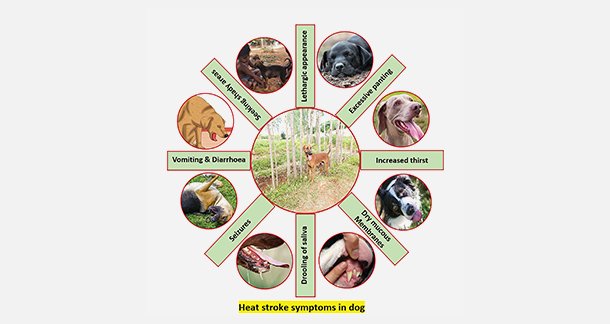
Every system (circulatory, nervous, digestive, and excretory systems) in the body is affected by heat stroke and shows different visible and clinical symptoms. Heart (elevated heart rate)
The signs of heatstroke include:
- Excessive and abnormal panting
- Seeking shady areas
- Increased thirst
- Dry or sticky or reddened gums/mucous membranes
- Bruising in the gums
- Increased heart rate
- Dehydration
- Elevated temperature above the normal range
- Vomiting
- Diarrhoea
- Disorientation/stumbling
- lethargic or disoriented appearance
- Seizures/death
- Drooling of saliva.
What to do if the dog shows heat stroke symptoms
If one or a combination of the above symptoms are noticed in dogs during a hot season, it may be due to heat stress and we should take appropriate steps to reduce the stress.
- The first and foremost step to do in the heat affected dog is, move the dog to a shaded and well ventilated place.
- Provide fresh and cool water
- Stop all physical activities of the dog and make it calm until the symptoms have resolved.
- Gradually lower the body temperature by wetting their body with normal water, except the face and a fan blowing over the damp skin will further cool them down.
- See a vet immediately
- Don’t wrap them with wet towels over the body as it will trap the heat that is trying to escape.
- Approach the vet before the situation worsens.

How to prevent of Heatstroke in Dogs
During the hotter months we should take all the steps to save our pet from the adverse effects of heat waves.
- Ensure that the pet has access to shade and cool drinking water throughout the day when they are outdoors.
- Select cooler parts of the day for exercise and avoid heavy exercise during the hotter months of the year.
- Never leave dogs in unattended or parked cars on hot days.
- If the dogs are indoors, the room must be well ventilated and provide the dog with an adequate amount of drinking water.
- Do not go for counter medication to reduce the body temperature.
- Utmost care is necessary for obese and brachycephalic (short-nosed) breeds, like pugs and bulldogs.
About the Author
Professor and Head
Department of Livestock Production Management
Veterinary College and Research Institute
Theni- 625534
(Tamil Nadu Veterinary and Animal Sciences University)